







My first experience of Artificial Intelligence (AI) being used in healthcare was at the end of last year when I made an emergency trip to the vet with a sick guinea pig. The vet asked if I was ok with him recording our consultation using his AI app. Not only did I say yes, but I also asked if he could show me how it worked. It was amazing to see our conversation appear in edited and accurate form organised under separate clinical headings. The app even removed our non-relevant discussions of the weather and school holidays! He had only recently started using it but it had already freed up so much of his time on administrative tasks that he was able to fit in another one to two consultations each day.
Artificial Intelligence Is Transforming Healthcare Worldwide
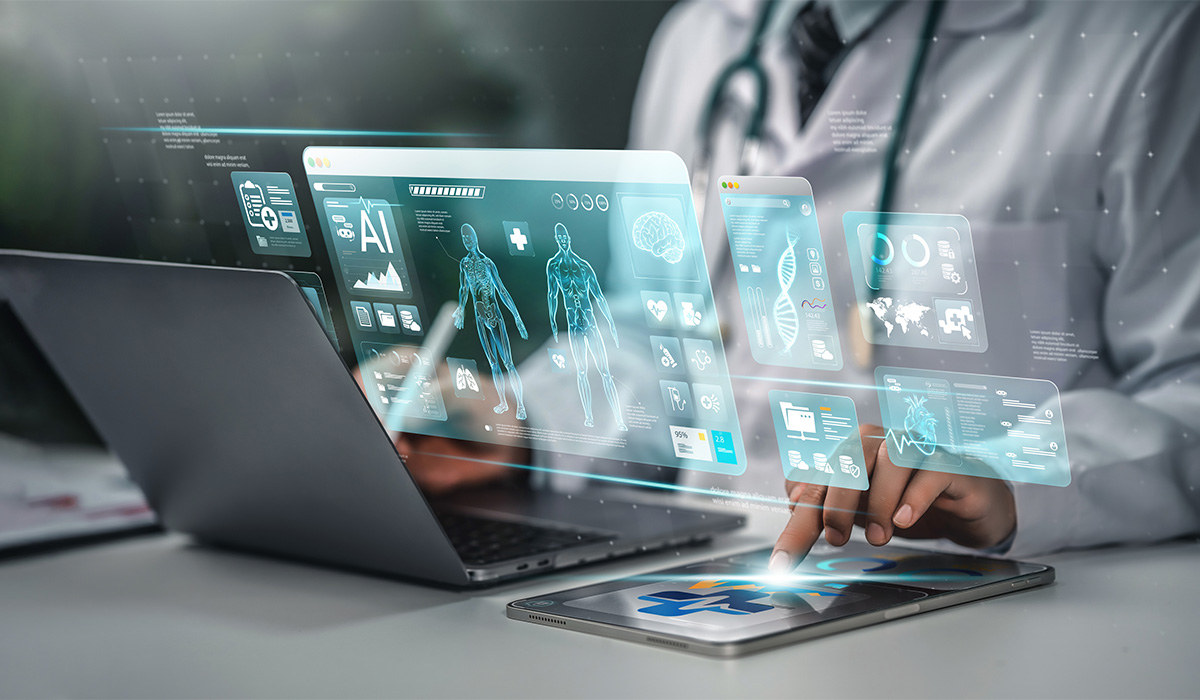
AI is shifting patient care away from a model that responds when a patient is sick to healthcare that is more proactive and driven by data. AI can help with early detection of diseases, offer more personalised treatments, automate repetitive tasks and make big gains in efficiency for daily operational and administrative tasks that take time away from patient care. Rather than replacing doctors and other healthcare practitioners, AI is increasingly freeing up their time and allowing them to focus on more complex decision-making and patient connection.
What Areas Of Health Are Using AI?
Worldwide, AI is currently most established in fields that rely heavily on pattern recognition, such as Radiology and Pathology. It is commonly used in the following areas:
Diagnostics And Imaging: AI algorithms can analyse X-rays, MRIs, CT scans, ECGs and histology slides to pick up early signs of disease or damage like lung cancer, breast tumours, fractures, COVID-19 changes and strokes. AI can often match or exceed human performance for specific tasks by being faster or more accurate in detecting or triaging diseases.1
Clinical Decision Support: AI tools can help clinicians by suggesting a diagnosis or a risk score to answer questions such as whether a patient should be readmitted to hospital or whether they need treatment for sepsis.2 AI can pick up medication interactions, recommend treatments or correct drug dosing and can help clinicians keep to clinical guidelines.3
Risk Prediction And Prognosis: Real-time patient data from emergency departments and ICUs can be analysed to predict the onset of sepsis or heart failure hours before clinical symptoms
appear, enabling life-saving early intervention. AI models can predict whether a patient may need readmission, has deteriorated or it can even calculate their risk of mortality.
Personalised Medicine: AI can analyse information from lots of different sources including a patient’s genetic make-up, their lifestyle and clinical data to tailor treatments specifically to them.
Drug Discovery: AI is helping scientists understand cellular proteins in the body in great detail. Cellular proteins are used as drug targets. AI can reduce the timeline for drug development from years to months by simulating how these molecules interact in the body. AI can rapidly analyse large amounts of data used in clinical research and drug trials.
Surgical Robotics: Robots use AI to stabilise surgeon hand movements and provide enhanced 3D views, leading to smaller incisions and faster recovery times.
How Can AI Help Health Practitioners?
AI has been able to significantly reduce the administrative burden that often leads to healthcare worker burnout. It can improve efficiency and reduce workloads in the following ways:
Clinical Intelligence: AI “scribes” listen to patient-clinician conversations and automatically generate clinical notes in real-time, reclaiming hundreds of hours that can be better used for direct patient care.
Virtual Assistants: AI “Chatbots” allow patients to self-triage their symptoms at home, providing 24/7 support and reducing unnecessary emergency room visits. Chatbots can schedule appointments or medication reminders and some can even provide mental health support. Symptom checkers and intake bots help direct patients to appropriate services and reduce call‑centre load.
Population health and predictive analytics: AI analyses administrative and primary care data to identify at-risk patient groups, manage chronic disease and plan healthcare services.
Remote Monitoring and Telehealth: AI-powered wearables can continuously track heart rates and glucose levels, alerting healthcare teams to abnormal trends before they become emergencies. Home-sensor data can be used for chronic disease management for conditions like diabetes, heart failure and COPD. This gives patients better access to healthcare by being able to access telehealth options and allows patients to be monitored remotely.
Improving Efficiency: AI tools can automate repetitive or administrative tasks like billing, optimising workflow or staffing, scheduling appointments and making forecasts that can reduce costs and improve efficiencies.
What Are The Challenges And Risks That Come With Using AI?
There are definitely some hurdles to overcome involving how AI is being used in healthcare:
- AI models can magnify health disparities if data lacks diversity (e.g., certain ethnicities are underrepresented).
- Many deep-learning models are difficult to interpret, making it a challenge for clinicians to explain AI-driven decisions to patients or for regulators to verify their safety.
- The use of massive datasets raises concerns about patient confidentiality and the risk of sensitive health data breaches.
- Health AI remains severely under-regulated globally.
What Will AI Look Like In The Future?
With AI here to stay, it’s likely that uptake of its capabilities will increase – more administrative tasks will be automated, the use of AI scribes will be widespread and precision will get even better for imaging and screening. These all have the potential to release time for patient care back to health professionals and enable them to focus more on what matters to their patients. AI has the potential to transform many aspects of healthcare so that in the future it is more precise, personal, portable and accessible to all of the world’s population, improving health equity and delivering a high standard of care to all people worldwide.4













Community